





BLOGSDETAILS
How long does it take to assemble a flat pack container house?
Author:Mingkai Time:2026-09-09 09:41:15 Click:193
How Long Does It Take to Assemble a Flat Pack Container House?
A flat pack container house is designed for relatively fast assembly compared with conventional buildings. Under suitable site conditions, a single standard unit can often be assembled within a short period, while larger projects with multiple units require more time for foundation preparation, positioning, structural connections, interior work, and utility installation.
The actual assembly time depends on the house size, structural design, number of workers, site conditions, foundation preparation, equipment, and the level of interior finishing.
How Long Does It Usually Take to Assemble a Flat Pack Container House?
For a standard flat pack container house, the main structural assembly may take around one day, provided that the foundation is already prepared and the required components are available on site.
However, this should not be interpreted as the complete project completion time.
A complete installation may also include:
Foundation preparation
Component unloading
Frame assembly
Wall and roof panel installation
Door and window installation
Electrical installation
Plumbing installation
Interior finishing
Exterior finishing
Final inspection
Therefore, the total project schedule can be longer than the basic structural assembly time.
What Is the Typical Assembly Process?
The installation of a flat pack container house generally follows several stages.
1. Site Preparation
Before the flat pack container house arrives, the installation area should be prepared.
The site should normally be:
Level
Stable
Accessible
Properly drained
Suitable for the planned foundation
Site preparation is important because an uneven or unstable base can affect the alignment of the modular structure.
2. Foundation Preparation
The foundation should be completed before the main house assembly begins.
Depending on the design and ground conditions, different foundation systems may be used, such as concrete pads, strip foundations, concrete slabs, or other engineered support systems.
The foundation needs to match the structural requirements of the specific flat pack container house.
3. Unloading Components
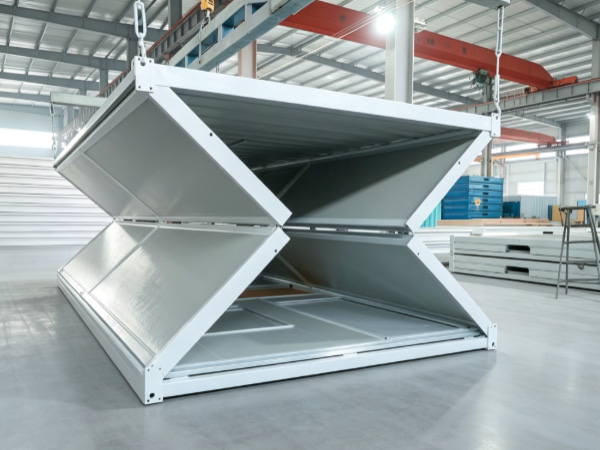
The flat pack container house is transported in a compact configuration. Once it arrives at the construction site, the components are unloaded and organized.
The required equipment depends on the product design, package weight, site access, and installation method.
4. Frame Assembly
The structural frame is assembled first.
Workers connect the main structural components according to the manufacturer's installation drawings. Accurate positioning at this stage helps ensure that the walls, roof, doors, and windows can be installed correctly.
5. Wall and Roof Installation
After the main frame is secured, wall panels and roof components are installed.
Insulation and other building-envelope components may also be incorporated depending on the design and local climate requirements.
6. Doors and Windows
Doors and windows are installed after the main wall structure is completed.
Proper alignment and sealing are important for weather resistance and long-term building performance.
7. Electrical and Plumbing Installation
The final stage may include electrical wiring, lighting, water supply, drainage, sanitary facilities, and other utilities.
The exact scope depends on whether the flat pack container house is supplied as a basic shell or as a more complete modular building.
What Factors Affect Assembly Time?
The installation time of a flat pack container house is not the same for every project.
Several factors can significantly affect the schedule.
House Size
A small single-unit building generally requires less installation work than a large modular complex.
Projects involving multiple interconnected units require additional structural connections, wall sections, roofing, utilities, and interior work.
Number of Workers
The number and experience of installers can influence the assembly schedule.
A properly organized installation team can complete repetitive assembly operations more efficiently, while insufficient manpower can extend the project timeline.
Foundation Condition
A prepared foundation can significantly simplify installation.
If the foundation is not ready when the building arrives, assembly may need to be delayed until the supporting structure has been completed and inspected.
Site Conditions
Site accessibility is another important consideration.
Narrow roads, limited unloading space, uneven terrain, poor weather, or difficult access for lifting equipment can increase installation time.
Building Configuration
A basic flat pack container house has a simpler installation process than a building with multiple rooms, bathrooms, kitchens, partitions, electrical systems, plumbing, and customized features.
Interior Finishing
If the project requires extensive interior finishing, the time required after structural assembly can be considerably longer.
Therefore, buyers should distinguish between structural assembly time and complete project completion time.
Does a Flat Pack Container House Require Heavy Equipment?
Not necessarily.
The equipment required depends on the specific flat pack container house design and the weight of its components.
Some projects may require lifting equipment for unloading and positioning, while smaller components can be handled manually by an installation team.
Before installation, it is important to confirm:
Component dimensions
Component weight
Unloading method
Required lifting equipment
Site access
Installation sequence
This can help prevent delays during the assembly process.
Can Multiple Flat Pack Container Houses Be Installed Quickly?
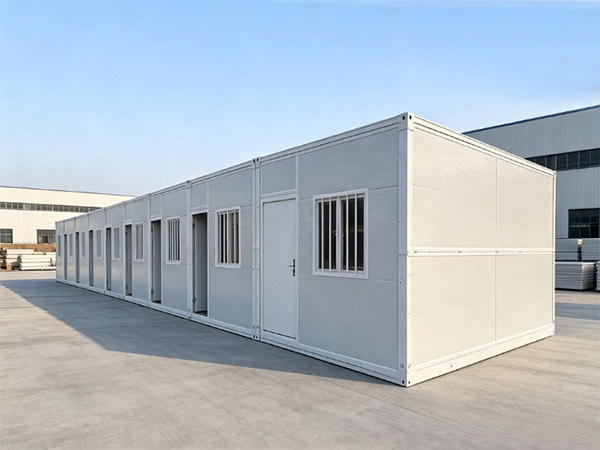
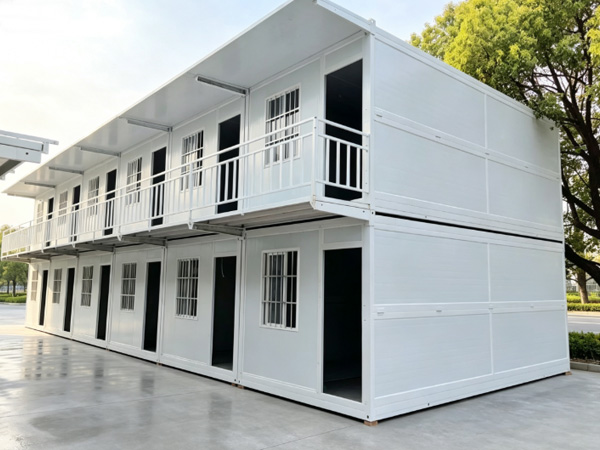
Yes. One of the advantages of modular construction is that multiple units can be assembled according to a planned installation sequence.
For example, a modular project may include:
Worker accommodation
Site offices
Dormitories
Temporary classrooms
Dining facilities
Security rooms
Sanitary facilities
Storage areas
When several units are combined into one project, installation efficiency can improve because workers can repeat similar assembly operations.
However, the overall schedule still depends on foundation work, utility connections, building layout, and local site conditions.
Is a Flat Pack Container House Faster Than Traditional Construction?
In many applications, yes.
A flat pack container house is manufactured using prefabricated components, meaning many construction elements are prepared before they reach the project site.
This can reduce the amount of conventional on-site construction work.
Traditional construction may involve extensive:
Material delivery
Cutting
Formwork
Masonry
Structural construction
On-site finishing
A flat pack container house moves a larger proportion of the building process toward standardized prefabrication and on-site assembly.
This can be particularly useful for temporary buildings, construction camps, remote projects, and projects where rapid deployment is important.
Can a Flat Pack Container House Be Installed in Bad Weather?
Weather can affect installation efficiency.
Light rain may not necessarily stop all assembly operations, but heavy rain, strong wind, snow, or severe weather can create safety and construction challenges.
Weather can affect:
Lifting operations
Roof installation
Electrical work
Waterproofing
Worker safety
Transportation
Foundation preparation
For this reason, the installation schedule should include appropriate consideration of local weather conditions.
How Can Assembly Time Be Reduced?
Several measures can help make installation more efficient.
Prepare the Foundation in Advance
The foundation should be completed and checked before the building components arrive.
Prepare the Installation Team
Workers should understand the installation drawings and assembly sequence before starting.
Organize Components
Components should be unloaded and arranged according to the installation sequence to minimize unnecessary movement.
Confirm Equipment
If lifting equipment is required, it should be arranged before delivery.
Prepare Utilities
Electrical, water, and drainage connection points should be planned before installation begins.
Use Standardized Components
Standardized modular components can simplify repeated installation operations, particularly for larger projects.
What Is the Difference Between Assembly Time and Project Completion Time?
This distinction is important when evaluating a flat pack container house.
Assembly time usually refers to the time required to construct the main physical structure.
Project completion time may include foundation work, installation, utilities, interior finishing, inspection, and site preparation.
For example, a project may have a relatively short structural assembly period but require additional time for electrical, plumbing, flooring, furniture, or other finishing work.
Therefore, buyers should ask suppliers to clarify exactly what is included in the quoted installation schedule.
What Should Buyers Ask Before Ordering?
Before purchasing a flat pack container house, it is useful to confirm:
How many workers are required for installation?
How long does the main structural assembly take?
Is the foundation included?
What type of foundation is required?
Is lifting equipment required?
What tools are needed?
Are installation drawings provided?
Is an installation manual included?
Are electrical and plumbing systems pre-installed?
How long does complete project installation normally take?
Does the installation time change for multiple connected units?
What local building requirements need to be considered?
These questions can help establish a more realistic project schedule.
Conclusion
How long does it take to assemble a flat pack container house? For a standard unit with a prepared foundation and suitable site conditions, the main structural assembly can often be completed in a relatively short time, potentially within a day. However, the complete installation schedule depends on the building configuration, number of units, workforce, foundation, utilities, interior finishing, equipment, and weather.
The main advantage of a flat pack container house is not simply fast assembly. Its prefabricated and modular construction can also help simplify transportation, reduce on-site construction work, and support flexible deployment for temporary or semi-permanent building projects.
Academic References
Hachem-Vermette, C., Dara, C., & Assefa, G. (2019). Life cycle assessment and life cycle costing of container-based single-family housing in Canada: A case study. Building and Environment, 163, 106332.
DOI: 10.1016/j.buildenv.2019.106332Satola, D., Kristiansen, A. B., Houlihan Wiberg, A., Gustavsen, A., Ma, T., & Wang, R. Z. (2020). Comparative life cycle assessment of various energy efficiency designs of a container-based housing unit in China: A case study. Building and Environment, 186, 107358.
DOI: 10.1016/j.buildenv.2020.107358Cambier, C., Galle, W., & De Temmerman, N. (2021). Expandable Houses: An Explorative Life Cycle Cost Analysis. Sustainability, 13(12), 6974.
DOI: 10.3390/su13126974Zheng, B., Yang, Y., Chi, H.-L., Luk, C., & Chan, A. (2025). Development of a BIM-based application for visualizing the reuse and recycling potential of modular building systems. Journal of Building Engineering, 105, 112500.
 HOT PRODUCT
 CONTACT US